May 19, 2026 | Business Finance | Banking & Lending | Credit & Underwriting | Leadership & Sales | Channel Insights
⚖️ Who Really Owns the Business Target?
And why is it almost always the Sales team alone?
When targets are announced at the beginning of the year, they are called “company targets.”
But in reality?
They become sales targets.
The Unspoken Structure
In most financial institutions:
• Sales owns the target
• Credit owns the risk
• Operations owns the process
• Compliance owns the rules
Sounds logical.
But here’s the real issue:
Only one function carries the pressure of revenue generation.
The Beginning-of-the-Month Syndrome.
Most sales teams quietly admit this.
During the first 8–10 days of the month, sales hesitates to push cases aggressively.
Why?
Because if a case is pushed too early and gets rejected or delayed, it hurts the month’s pipeline.
So the month becomes a psychological game:
Early days → cautious
Mid-month → selective push
Last week → pressure cooker
This is not efficient for anyone.
The Classic Response from Credit, Sales often hears this line:
“The target is yours, not ours. You earn incentives. Credit does not.”
Technically correct.
But strategically flawed.
Because business generation is not a single-department responsibility.
Let’s Acknowledge a Basic Truth
Sales is the engine of any company.
Business flows through that engine.
Without it:
No revenue
No profit
No increments
No promotions
No ESOPs
No bonuses
Every vertical in the organization ultimately benefits from the revenue created through the sales engine.
But This Is Not About Diluting Credit Discipline.
Credit should never compromise on underwriting.
Risk assessment is critical to protecting the balance sheet.
But there is a difference between:
✔ Independent risk evaluation
and
✖ Organizational detachment from business goals.
Credit and sales should operate as counterbalances, not opposing camps.
What Collaboration Could Look Like
Imagine a model where:
• Sales and credit jointly discuss early-stage cases
• Risk flags are identified earlier in the process
• Structuring happens before submission
• Rejections reduce significantly
Instead of friction, you create alignment.
Instead of late-stage surprises, you create early-stage clarity.
The Real Question for the Industry
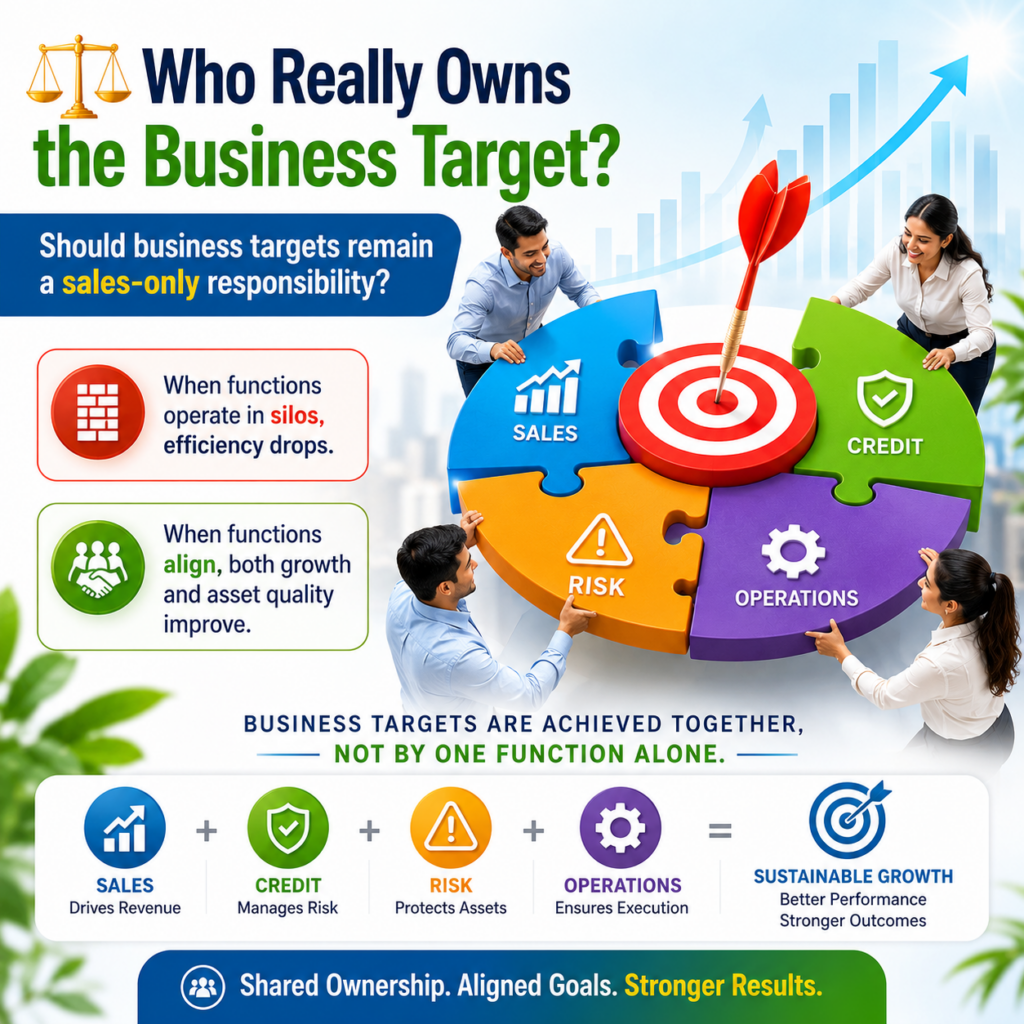
Should business targets remain a sales-only responsibility?
OR
should revenue creation be treated as a shared organizational objective across sales, credit and risk teams?
Because when functions operate in silos, efficiency drops.
But when functions align, both growth and asset quality improve.
Curious to hear perspectives from:
Bankers
Credit professionals
Risk officers
Sales leaders
Should targets remain sales-driven?
Or should they become organizationally owned?
#BusinessTargets #SalesLeadership #CreditRisk #BankingIndustry #LendingBusiness #RiskManagement #BusinessGrowth #OrganizationalAlignment #LeadershipInsights #FinancialServices #SalesAndCredit #AssetQuality #BusinessStrategy #OperationalEfficiency #TeamAlignment #BankingProfessionals #CreditCulture #GrowthMindset #BusinessTransformation #CorporateLeadership #CollaborationMatters #RevenueGrowth #SalesTeams #RiskOfficers #CreditProfessionals #BusinessOperations #FinancialLeadership #LinkedInBusiness #LeadershipConversation #IndustryInsights


