August 4, 2026 | Business Finance | Banking & Lending | Credit & Underwriting | Leadership & Sales | Channel Insights
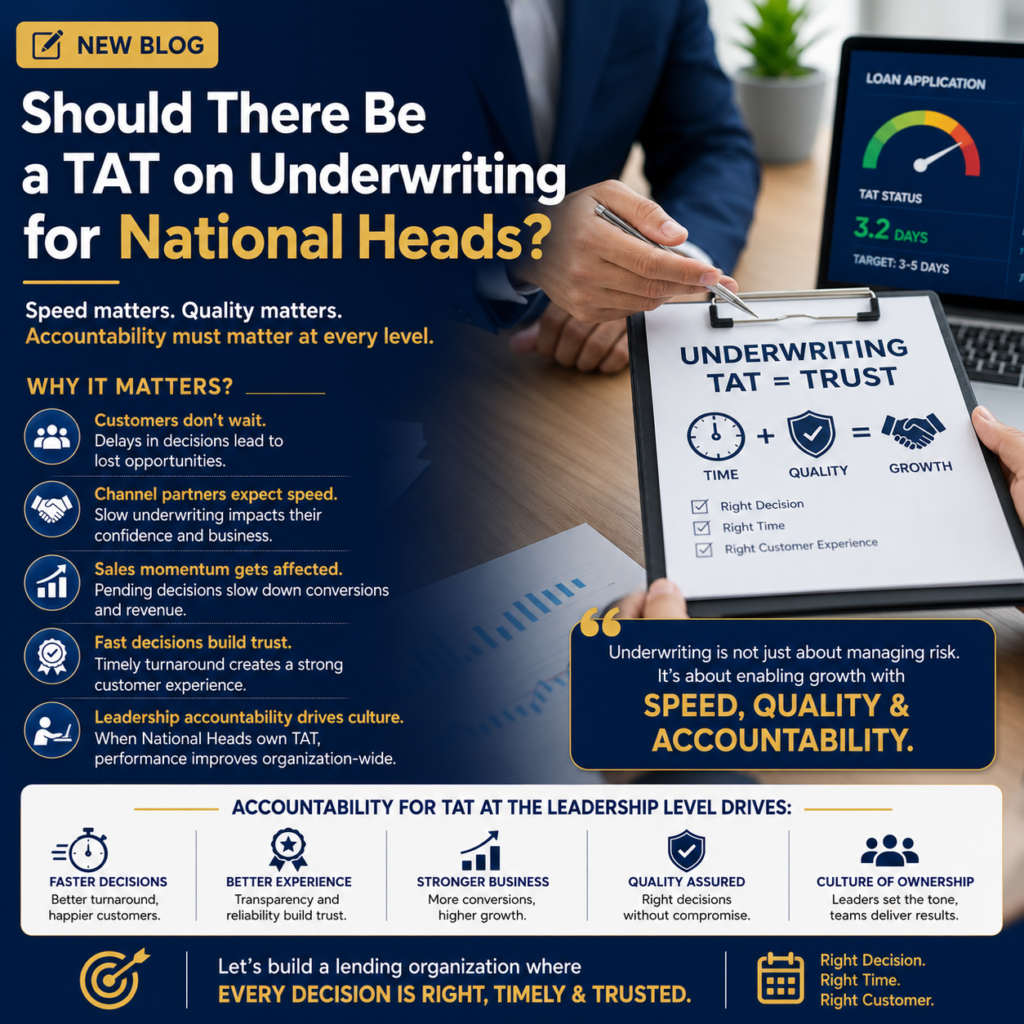
Should There Be a TAT on Underwriting for National Heads?
In banking, speed matters. But should accountability for speed stop at the underwriting desk?
Every financial institution proudly speaks about customer experience, faster loan approvals, and operational excellence.
Sales teams are assigned monthly targets.
Relationship Managers are measured on business volumes.
Operations teams are evaluated on processing efficiency.
Collections have recovery targets.
Credit teams have quality metrics.
But one important question often goes unasked.
Should National Heads also be accountable for underwriting turnaround time (TAT)?
Underwriting Is More Than Credit Assessment
Underwriting is the backbone of lending.
Every decision affects portfolio quality, profitability, and risk management.
No one expects credit decisions to be rushed at the cost of quality.
However, speed and quality are not mutually exclusive.
The real objective is to deliver the right decision within the right timeframe.
Because in today’s competitive market, a delayed decision is often equivalent to a declined opportunity.
Customers Don’t Wait
Businesses require funding when opportunities arise—not weeks later.
Whether it is:
- Working Capital
- Loan Against Property
- Business Loans
- Construction Finance
- Equipment Finance
customers expect timely decisions.
If one lender takes ten days while another takes three, the customer rarely waits.
The opportunity simply moves elsewhere.
Delay Has a Cost
Every additional day in underwriting has a business impact.
- Customers lose confidence.
- Channel partners become frustrated.
- Sales teams struggle to provide updates.
- Competitors gain an advantage.
- Revenue gets delayed—or lost altogether.
A loan may eventually be approved, but if the customer has already accepted another offer, the approval has little value.
Sometimes the fastest “No” is more valuable than the slowest “Yes.”
Accountability Should Flow Across the Organization
In most organizations, sales teams are measured daily.
Credit teams are monitored for productivity.
Operations have service-level expectations.
The question is:
Should the leadership responsible for underwriting also have measurable service commitments?
Not to compromise credit quality.
Not to increase unnecessary pressure.
But to create ownership for delivering timely decisions.
Leadership accountability sends a powerful message throughout the organization.
Measuring Speed Without Compromising Quality
A well-designed underwriting TAT should never encourage hurried decisions.
Instead, it should focus on measurable operational excellence, such as:
- Average turnaround time from login to decision.
- Time taken after receiving complete documentation.
- Percentage of cases completed within defined service levels.
- Customer and channel experience.
- Quality of communication during the underwriting process.
When these metrics are reviewed consistently, organizations improve without sacrificing credit discipline.
Technology Can Help—But Leadership Must Lead
Many banks and NBFCs have invested heavily in technology.
Digital onboarding.
Automated workflows.
AI-assisted underwriting.
Real-time dashboards.
Yet technology alone cannot reduce delays if ownership is missing.
Systems improve efficiency.
Leadership creates accountability.
The best-performing institutions combine both.
What About Complex Cases?
Not every proposal is straightforward.
Large-ticket loans, structured transactions, or cases requiring legal and technical evaluations will naturally take longer.
That is perfectly reasonable.
However, complexity should come with transparency.
Customers and channel partners appreciate honest communication.
A clear update explaining why additional time is required builds far more confidence than prolonged silence.
Building a Culture of Predictability
The objective is not to approve every loan quickly.
The objective is to ensure that every customer receives a timely, transparent, and well-reasoned decision.
Organizations that consistently deliver predictable underwriting timelines earn something even more valuable than business.
They earn trust.
And in financial services, trust is one of the strongest competitive advantages.
Final Thoughts
Sales teams are accountable for bringing business.
Credit teams are accountable for assessing risk.
Operations are accountable for execution.
Leadership should be accountable for creating an environment where decisions happen efficiently, responsibly, and consistently.
Perhaps the conversation should not be:
Should there be a TAT for underwriting?
Instead, it should be:
Should every level of leadership be accountable for the customer experience created by underwriting?
Because underwriting is not just about managing risk.
It is also about enabling growth.
And growth thrives when speed, quality, and accountability work together.


