July 28, 2026 | Business Finance | Banking & Lending | Credit & Underwriting | Leadership & Sales | Channel Insights
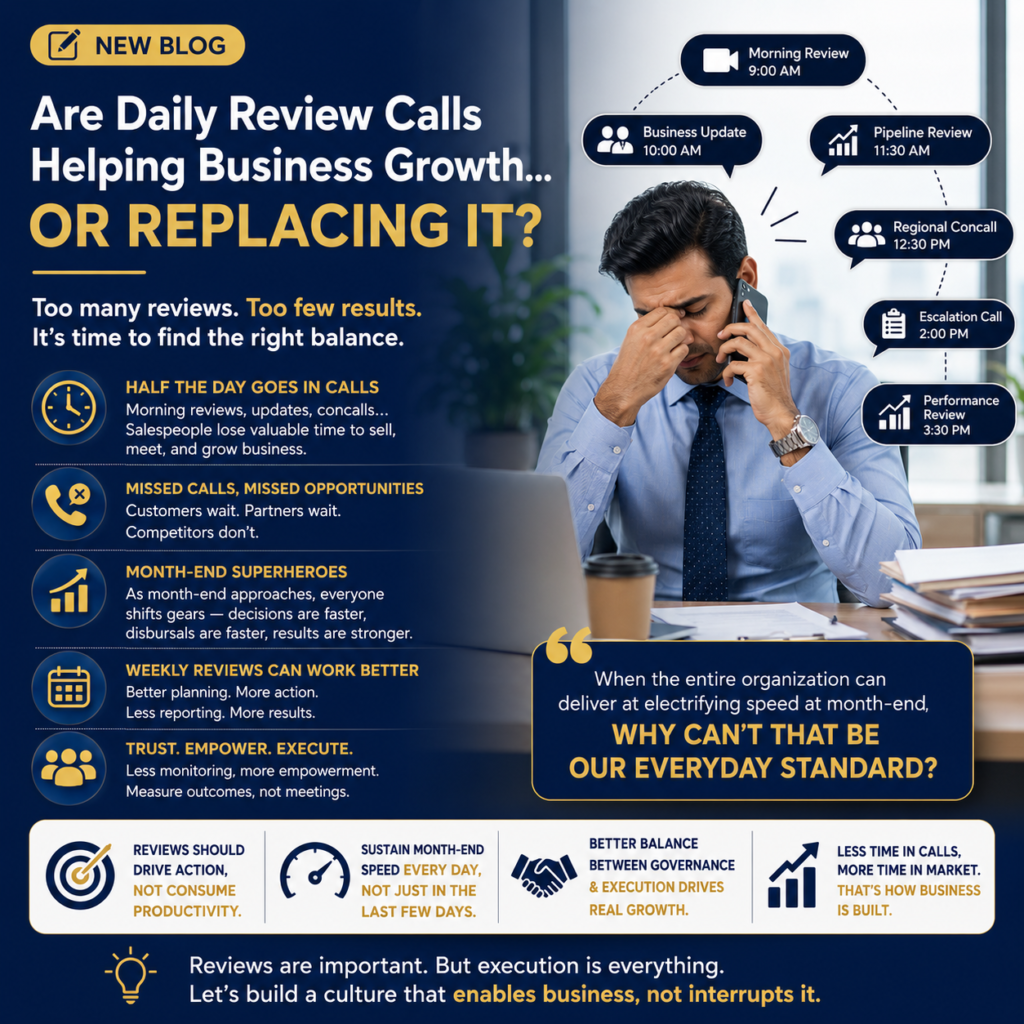
Are Daily Review Calls Helping Business Growth… or Replacing It?
“You cannot expect sales growth if your sales team spends more time reporting than selling.”
Across the banking and NBFC industry, daily morning review meetings and conference calls have become part of the operating culture.
Every morning begins with updates.
Business numbers.
Pipeline discussions.
Pending cases.
Target achievement.
Escalations.
Action points.
While reviews are essential for governance and performance tracking, one important question deserves attention:
Have daily reviews become so frequent that they are reducing the time available to generate business?
The Hidden Cost of Daily Reviews
A sales professional starts the day by preparing for the morning review.
This is followed by departmental meetings, regional discussions, business updates, and conference calls.
Before they realize it, half the working day has already passed.
During this period:
- Customer calls remain unanswered.
- Channel partners struggle to get updates.
- Relationship meetings get postponed.
- Follow-ups with credit teams are delayed.
- Fresh business sourcing takes a back seat.
Ironically, the very people responsible for generating revenue often spend their most productive hours discussing revenue instead of creating it.
Sales Happens in the Market, Not in Meeting Rooms
Banking remains a relationship-driven business.
Customers expect quick responses.
Channel partners expect timely updates.
Business opportunities often have a short window.
Every delayed call or unanswered message creates an opportunity for a competitor.
Sales professionals build business by meeting customers, engaging with channel partners, resolving queries, and closing opportunities—not by attending back-to-back review calls.
Productivity Should Be Measured by Outcomes
Reviews should answer one simple question:
“How can we help the team achieve better business?”
Unfortunately, in many organizations, reviews become focused on reporting rather than problem-solving.
When reporting consumes a significant portion of the working day, productivity naturally suffers.
The purpose of a review should be to remove roadblocks—not to become one.
The Frustration Isn’t Limited to Sales Teams
Interestingly, this concern isn’t limited to frontline sales professionals.
Many Business Heads privately acknowledge the same challenge.
They often find themselves attending multiple reviews every day with different levels of management.
Instead of focusing on strategy, market expansion, team coaching, or customer engagement, a considerable part of their day is spent preparing presentations and sharing the same information repeatedly.
This creates a ripple effect across the organization.
If leaders spend their day reporting upward, their teams receive less coaching, guidance, and support.
When Reviews Become a Routine Rather Than a Tool
Reviews are most effective when they help leaders make better decisions.
However, when they become a daily ritual regardless of business needs, they risk losing their effectiveness.
A business review should answer questions such as:
- What is working?
- What is not working?
- Where are the bottlenecks?
- What support does the team need?
- What decisions can leadership make today?
If the same discussions are repeated every morning without meaningful action, the review becomes a reporting exercise rather than a business improvement exercise.
Could Weekly Reviews Deliver Better Results?
Not every business requires the same frequency of review.
For many lending businesses, a structured weekly review—supported by live dashboards and MIS—can provide sufficient visibility while allowing sales teams to focus on execution.
Daily reviews may still be necessary during:
- Quarter-end
- Financial year-end
- Major product launches
- Special business drives
- Critical portfolio situations
Outside these periods, organizations may benefit from empowering teams to spend more time in the market than on conference calls.
Trust Drives Performance
Leadership is not about monitoring every hour of the day.
It is about creating an environment where people are accountable for outcomes.
Sales professionals should certainly be accountable for their targets.
But accountability should be measured through business generated, customer satisfaction, portfolio quality, and execution—not by the number of review calls attended.
Final Thoughts
Every review has a cost.
That cost is measured not only in time but also in missed customer conversations, delayed decisions, and lost business opportunities.
The objective of any review process should be simple:
Enable the business—not interrupt it.
As the banking and NBFC industry becomes increasingly competitive, organizations that strike the right balance between governance and execution will build stronger customer relationships, happier sales teams, and better business outcomes.
Perhaps it’s time to ask a simple question:
Are we reviewing the business… or replacing the time needed to build it?


