November 23, 2026 | Business Finance | Banking & Lending | Credit & Underwriting | Leadership & Sales | Channel Insights
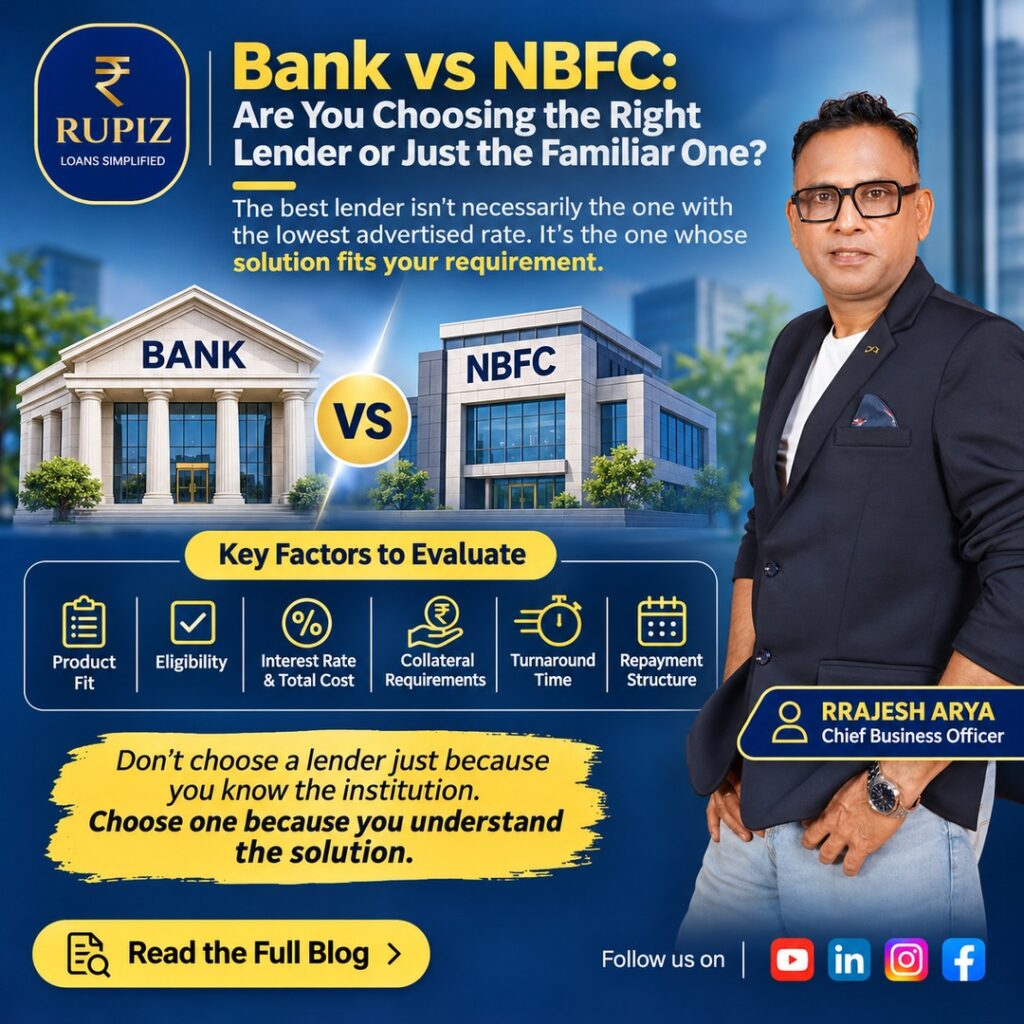
Bank vs NBFC: Are You Choosing the Right Lender or Just the Familiar One?
The best lender isn’t necessarily the one with the lowest advertised rate. It’s the one whose solution fits your requirement.
When a business needs funding, the first instinct of many entrepreneurs is to approach the bank where they already maintain their current account or have an existing relationship.
Others may approach an NBFC because they believe the process will be faster or the eligibility criteria will be more flexible.
But is familiarity the right reason to choose a lender?
A business may have a strong banking relationship but still not fit the bank’s credit policy for a particular loan. Similarly, an NBFC may offer a suitable product, but its pricing, repayment structure or collateral requirements may not work for that business.
The reality is that banks and NBFCs serve different borrower profiles and funding requirements. Neither category is automatically better than the other.
The real question is not whether you should borrow from a bank or an NBFC. It is which lender is best suited to your business requirement.
Let’s understand the key factors every entrepreneur and finance professional should evaluate before choosing a lender.
1. Product Fit: Does the Lender Offer the Right Solution?
Every funding requirement is different.
A business looking for working capital has a different requirement from one purchasing machinery, acquiring commercial property or expanding its manufacturing capacity.
Banks and NBFCs may offer products such as:
- Loan Against Property (LAP).
- Unsecured Business Loans.
- Working Capital Facilities.
- Cash Credit and Overdraft.
- Machinery and Equipment Finance.
- Construction Finance.
- Project Funding.
- Term Loans.
- Balance Transfer and Top-Up Facilities.
However, product availability does not necessarily mean that every lender will finance every type of requirement.
For example, a manufacturing business may need ₹3 crore for machinery. One lender may offer a specialised equipment finance programme, while another may consider the requirement under a general term loan structure.
Similarly, a business seeking ₹5 crore in working capital may find that one lender’s assessment methodology is better suited to its turnover, banking and GST profile.
The first step should be identifying the appropriate funding product—not approaching the most familiar lender.
2. Eligibility: Does Your Business Fit the Lender’s Credit Policy?
This is one of the most important differences borrowers need to understand.
Different lenders may evaluate the same business differently.
Their credit assessment may consider:
- Annual turnover and business vintage.
- Profitability and net worth.
- Banking transactions and average balances.
- GST returns and consistency of filings.
- Existing loan obligations.
- CIBIL and other credit bureau information.
- Industry and business profile.
- Collateral availability and valuation.
- Repayment capacity.
Consider a business with annual turnover of ₹15 crore.
Its financial statements may show moderate profitability, but its banking transactions and GST filings may demonstrate healthy business activity.
One lender may primarily assess the proposal through reported profitability, while another may have a suitable banking or turnover-based assessment programme, subject to its credit policy.
This does not mean one lender is less stringent than another. Their assessment approaches and risk appetites may simply differ.
For borrowers, understanding these differences before applying can save time and avoid unnecessary credit enquiries.
3. Interest Rate: Are You Comparing the Actual Cost or Just the Advertised Rate?
Interest rates are often the first thing borrowers compare.
And rightly so. The cost of borrowing has a direct impact on business profitability and cash flow.
However, comparing only the advertised interest rate can be misleading.
Consider two hypothetical funding proposals:
| Particulars | Lender A | Lender B |
| Loan amount | ₹1 crore | ₹1 crore |
| Interest rate | 10.50% | 11.25% |
| Tenure | 5 years | 7 years |
| Processing charges | As quoted | As quoted |
| Repayment structure | Monthly EMI | Monthly EMI |
Lender A offers a lower interest rate, but Lender B offers a longer repayment period.
Which is better?
There is no automatic answer.
A longer tenure may reduce the monthly EMI and ease cash-flow pressure, but it can increase the total interest payable over the loan period.
Borrowers should compare:
- Interest rate and whether it is fixed or floating.
- Processing and other applicable charges.
- Loan tenure.
- Total interest payable.
- EMI or repayment obligations.
- Prepayment and foreclosure conditions.
- Insurance and other applicable costs.
The lowest interest rate does not always translate into the most suitable borrowing solution.
The objective should be to evaluate the total cost and financial impact of the facility.
4. Collateral: What Security Does the Lender Require?
Collateral requirements can significantly influence lender selection.
For a secured business loan or Loan Against Property, lenders may evaluate:
- Property ownership and title.
- Property location and marketability.
- Technical and legal valuation.
- Loan-to-Value (LTV) ratio.
- Existing encumbrances.
- Property usage and construction status.
Different lenders may have different approaches to property valuation, acceptable security types, LTV and legal requirements.
For instance, a borrower may own an industrial property, warehouse, commercial premises or residential property.
While one lender may have a suitable programme for that property category, another may have restrictions or different valuation parameters.
For unsecured funding, collateral may not be required, but the lender may place greater emphasis on financial performance, banking conduct, credit history and repayment capacity.
The borrower should therefore understand the security requirements before selecting a lender.
5. Turnaround Time: How Important Is Speed?
For a business, time can be money.
A delayed loan sanction can affect machinery purchases, property transactions, project execution, inventory procurement or business expansion.
Some lenders may have streamlined digital processes and faster assessment mechanisms for specific products.
Others may require more detailed financial, technical, legal or collateral evaluations.
The turnaround time can depend on:
- Completeness of documentation.
- Complexity of the loan structure.
- Borrower eligibility.
- Property valuation and legal checks.
- Credit approval requirements.
- Internal lender processes.
- Regulatory and compliance checks.
It would be incorrect to assume that every NBFC is faster than every bank.
A well-prepared application submitted to the right lender can often progress more efficiently than an incomplete application submitted to multiple institutions.
Speed is important, but speed without proper assessment can become an expensive mistake.
6. Repayment Structure: Can Your Business Comfortably Service the Loan?
This is perhaps the most overlooked aspect of lender selection.
Entrepreneurs often focus on the loan amount and interest rate but give less attention to the repayment structure.
A business generating seasonal cash flows may require a different repayment arrangement from one receiving regular monthly collections.
For example:
- A manufacturing company may need working capital aligned with its operating cycle.
- A hospital purchasing medical equipment may prefer a repayment period aligned with the equipment’s useful economic life.
- A real estate developer may require milestone-linked or structured disbursements.
- A business acquiring property may need a longer-term repayment structure.
Depending on the product and lender policy, available structures may include monthly EMIs, principal moratoriums, overdraft facilities, interest-serviced arrangements or structured repayment schedules.
However, not every lender offers every structure.
The right facility should match the purpose of borrowing and the business’s ability to generate cash flow.
A loan that is easy to obtain but difficult to repay is not necessarily a good funding decision.
7. Relationship Banking vs Lender Suitability
Maintaining a relationship with your existing bank has its advantages.
The bank may already understand your business operations, banking transactions, financial history and account conduct.
This can help in certain situations.
However, an existing relationship does not guarantee that the bank will offer the most suitable product, pricing, eligibility programme or loan structure.
Similarly, choosing an NBFC simply because someone recommends it may not necessarily be the right decision.
Borrowers should evaluate the actual proposal rather than the lender’s brand or category.
A familiar lender may be a good choice. An unfamiliar lender may also offer a better-suited solution.
Lender selection should be based on suitability, not habit.
8. How Should an Entrepreneur Choose Between a Bank and an NBFC?
Before approaching any lender, evaluate the following factors.
| Evaluation parameter | What should you check? |
| Product fit | Does the lender offer the right facility? |
| Eligibility | Does your financial profile match its credit policy? |
| Pricing | What is the complete cost of borrowing? |
| Collateral | What security is required and what LTV is available? |
| Turnaround time | What is the realistic processing timeline? |
| Repayment | Does the repayment structure suit your cash flow? |
| Flexibility | Are there suitable options for prepayment, top-up or restructuring? |
| Documentation | Can you meet the lender’s requirements? |
Do not select a lender based on just one parameter.
A slightly higher-priced loan may offer a more appropriate tenure or repayment structure. A lower-priced loan may be unsuitable if the security requirements or eligibility conditions cannot be met.
The decision should be based on the complete funding proposition.
9. The Role of a Finance Partner: Looking Beyond the Lender’s Name
Many entrepreneurs approach lenders only when they urgently need funds.
They submit documents, wait for an assessment and then discover that the proposal does not fit the lender’s credit policy.
The process may then restart with another institution.
This is where a finance partner can add value.
A structured funding approach should begin by understanding:
- Why does the business need funding?
- How much funding is actually required?
- Which loan product is appropriate?
- What is the existing debt burden?
- What is the business’s repayment capacity?
- Which lenders have suitable programmes for the borrower’s profile?
- What funding structure will support the business without creating unnecessary financial pressure?
At RUPIZ, we believe that successful loan distribution is not simply about connecting borrowers with lenders.
It is about understanding the business requirement, assessing funding readiness and identifying suitable lending options across banks and NBFCs.
With access to multiple lending relationships, the objective is to help businesses explore appropriate funding solutions rather than depend entirely on one familiar institution.
Conclusion: Choose the Right Lender, Not Just the Familiar One
Banks and NBFCs both play an important role in India’s business financing ecosystem.
Each has its own products, credit policies, risk appetite, pricing structures and assessment methodologies.
There is no universal winner.
A bank may be the right choice for one business, while an NBFC may be more suitable for another. In some cases, a business may benefit from maintaining relationships with multiple lenders for different funding requirements.
The important thing is to understand the complete proposal before making a borrowing decision.
Do not compare lenders only by their advertised interest rates.
Compare their product suitability, eligibility criteria, collateral requirements, turnaround time, total borrowing cost and repayment structure.
Because the best loan is not necessarily the one that gets sanctioned first or carries the lowest rate.
It is the one that meets your business requirement, fits your financial profile and supports your long-term growth.
RUPIZ — Loans Simplified
The right funding solution begins with choosing the right lender.
Categories
Recent Posts
- Bank vs NBFC: Are You Choosing the Right Lender or Just the Familiar One?
- AI Is Changing Lending. Will It Make Business Loans Easier—or Tougher?
- The Hidden Cost of Borrowing from Too Many Lenders
- Funding Growth vs. Funding Survival
- Why Every Growing Business Needs a Finance Partner, Not Just a Lender


