October 13, 2026 | Business Finance | Banking & Lending | Credit & Underwriting | Leadership & Sales | Channel Insights
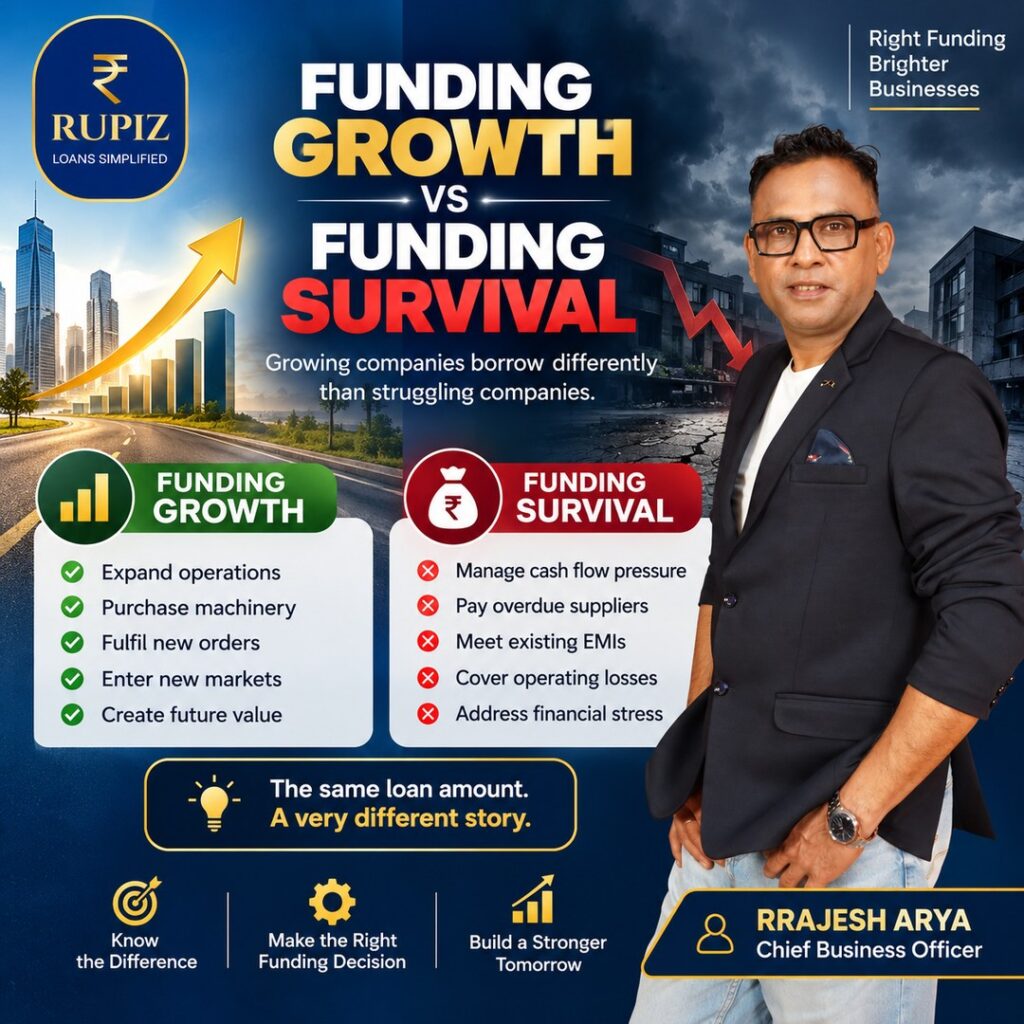
Funding Growth vs. Funding Survival
Why Growing Companies Borrow Differently from Struggling Companies
Not all borrowing is a sign of growth. Sometimes, it is a sign of financial pressure. The difference lies in why a business needs the money, how it plans to use it, and how it expects to repay it.
Two companies may have similar turnovers, operate in the same industry, and approach the same bank for the same amount of funding.
Yet, their financial situations can be completely different.
One company wants to borrow ₹5 crore to expand production, purchase machinery, fulfil confirmed orders, or enter a new market.
The other wants ₹5 crore to pay overdue suppliers, cover salary obligations, repay existing EMIs, or manage a persistent cash flow shortage.
Both companies need funding. But they may need very different financial solutions.
This is the distinction between funding growth and funding survival.
For business owners, CFOs, finance heads, and lenders, understanding this difference is essential to making responsible borrowing decisions.
1. Funding Growth: Borrowing to Create Future Value
Growth funding is generally driven by a clear business opportunity.
The company has identified a demand, an expansion plan, an investment opportunity, or a capacity constraint. It needs capital to execute that plan.
The purpose of borrowing is to strengthen the business and generate future economic value.
Common examples of growth funding
- Expansion: Opening a new branch, entering a new market, or increasing production capacity.
- Working capital: Financing inventory and receivables to fulfil growing orders.
- Machinery finance: Investing in equipment that improves productivity or enables higher output.
- Project finance: Funding a viable project with a defined investment plan and projected cash flows.
- Acquisitions: Acquiring a business, asset, or operation that supports a strategic objective.
- Technology and infrastructure: Investing in systems that improve efficiency and scalability.
What does a growth-oriented borrower look like?
A business borrowing for growth should ideally be able to explain:
- What opportunity is it trying to capture?
- How much funding is required, and how was the amount calculated?
- How will the funds be deployed?
- What additional revenue, savings, or operational benefits are expected?
- How will the business service the additional debt?
- What happens if growth is slower than projected?
The strongest growth-funding proposals are supported by realistic assumptions, credible financial information, and a clear repayment plan.
The key principle: Borrowing for growth should be supported by a business case—not just an optimistic forecast.
Even a promising expansion can create financial pressure if costs rise, collections are delayed, or demand fails to meet expectations. Therefore, growth funding must be evaluated against both potential returns and downside risks.
2. Funding Survival: Borrowing to Manage Financial Pressure
Survival funding arises when a business faces financial stress and needs money to maintain operations, meet obligations, or bridge a cash flow shortage.
Not every survival-related borrowing requirement indicates a failing business. Even otherwise healthy companies can face temporary liquidity problems because of delayed customer payments, seasonal fluctuations, or unexpected expenses.
The concern arises when the need for borrowing becomes recurring and the business has no credible path to restoring sustainable cash flow.
Common examples of survival funding
- Borrowing to pay overdue suppliers.
- Taking fresh loans to meet existing EMI obligations.
- Repeatedly extending short-term borrowing to cover operating losses.
- Using unsecured loans to support a business with persistently weak cash flows.
- Borrowing to meet statutory dues or salary commitments.
- Increasing working capital utilisation without a corresponding improvement in collections.
These situations require careful diagnosis.
For instance, a company waiting for payment from a creditworthy customer may need temporary liquidity support. A company that consistently sells below cost, accumulates losses, and borrows repeatedly to pay interest faces a very different problem.
The first may have a temporary cash flow mismatch. The second may have a deeper business viability issue.
The Reserve Bank of India has identified warning signs of financial stress that include repeated repayment delays, irregularities in credit facilities, unpaid supplier or statutory obligations, and cash flows that may be insufficient to service debt. These are important indicators to investigate, rather than reasons to assume every borrower facing a temporary shortage is unviable.
3. Funding Growth vs. Funding Survival: The Key Differences
| Parameter | Funding Growth | Funding Survival |
| Primary objective | Create future business value | Manage immediate financial pressure |
| Reason for borrowing | Expansion, orders, assets or capacity | Liquidity gaps, overdue payments or losses |
| Cash flow | Ideally supports existing debt and projected repayments | May be strained, uncertain or insufficient |
| Business plan | Defined investment and growth objectives | Often focused on urgent obligations |
| Repayment source | Operating cash flow and expected business returns | May depend on collections, cost reductions or financial recovery |
| Key risk | Growth underperforms expectations | Financial stress continues or worsens |
| Funding approach | Match capital to the opportunity and repayment profile | Diagnose the cause of stress before deciding on further debt |
| Desired outcome | Sustainable expansion | Stabilised cash flow and restored financial viability |
The distinction is not always black and white. A business can simultaneously pursue expansion and face liquidity pressure.
What matters is identifying which requirement is driving the borrowing decision and whether the proposed financing is appropriate.
4. Why the Same Loan Can Be a Growth Tool for One Business and a Risk for Another
Consider two hypothetical businesses.
Business A: Funding Growth
Established manufacturer
The company has received additional orders and needs ₹2 crore to purchase machinery and increase production capacity.
- Existing operations generate positive cash flow.
- Customer demand supports the expansion plan.
- Management has estimated the investment, operating costs and repayment requirements.
- A downside scenario has been considered if orders are delayed.
Funding objective: Increase capacity and generate additional business revenue.
Potentially suitable for growth funding, subject to lender assessment.
Business B: Funding Survival
Financially stressed trading business
The company also needs ₹2 crore, but the funds are intended to pay overdue suppliers and service existing debt.
- Customer collections have slowed significantly.
- Existing credit facilities are heavily utilised.
- Profit margins have declined.
- Management has no clear timeline for restoring cash flow.
Funding objective: Meet immediate obligations and keep operations running.
Requires a deeper assessment of cash flow, viability and repayment capacity before additional borrowing.
Both companies need the same amount of money.
But the purpose, repayment source, risk profile and likely impact of borrowing are different.
The amount of funding required does not tell the complete story. The financial condition of the business and the purpose of borrowing matter just as much.
5. The Biggest Mistake: Treating a Cash Flow Problem as a Funding Problem
One of the most important questions a business owner should ask is:
“Do I genuinely need more capital, or do I need to fix the way my business generates and manages cash?”
A business can report healthy sales and still experience a shortage of cash.
This can happen when:
- Customers take too long to pay.
- Inventory remains unsold for extended periods.
- Profit margins are insufficient.
- Operating expenses are growing faster than revenue.
- Too much capital is tied up in receivables.
- Debt repayments are excessive relative to cash generation.
In such cases, additional funding may provide temporary relief. However, unless the underlying issue is addressed, the business could become increasingly dependent on borrowing.
Before taking another loan, management should review its cash conversion cycle, receivables ageing, inventory turnover, margins, fixed costs and existing debt obligations.
If the business is fundamentally viable but facing temporary liquidity pressure, suitable working capital support may be worth evaluating. If it is experiencing persistent operating losses, a broader turnaround plan may be necessary.
More borrowing is not always the answer. Sometimes, better cash flow management is.
6. How Should a Business Decide Which Type of Funding It Needs?
Before approaching a bank or NBFC, business owners should assess five areas.
A. Purpose of funding
Clearly identify whether the requirement is for expansion, working capital, asset purchase, refinancing, or meeting immediate obligations.
Avoid combining multiple requirements into one borrowing proposal without understanding the funding needs separately.
B. Cash flow and repayment capacity
Prepare realistic cash flow projections.
Consider existing EMIs, supplier payments, salaries, taxes, working capital requirements and the proposed new repayment obligation.
Do not rely exclusively on projected revenue growth to justify additional debt.
C. Existing debt position
Review outstanding loans, interest costs, repayment schedules, credit utilisation and overdue obligations.
Determine whether the business can reasonably service additional borrowing without creating excessive financial pressure.
D. Financial viability
If funding is intended to rescue a stressed business, identify what caused the stress.
Is the problem temporary, such as delayed customer collections? Or is it structural, such as declining demand, persistent losses or unsustainable debt?
The proposed solution should reflect the actual problem.
E. Appropriate funding structure
Different requirements may call for different products, depending on eligibility and lender policy.
For example:
- Working capital facilities for eligible operating-cycle requirements.
- Machinery finance for productive assets.
- Loan Against Property for suitable secured borrowing needs.
- Term loans for defined investments with appropriate repayment schedules.
- Refinancing or restructuring options where eligible and financially viable.
The objective is to select a funding structure that matches the requirement and the business’s capacity to repay—not merely the product that is easiest to obtain.
7. What Should Lenders and Finance Partners Look Beyond?
A responsible funding assessment should go beyond the immediate loan requirement.
Important considerations include:
- Historical and projected cash flows.
- Revenue quality and profitability.
- Banking conduct and repayment history.
- Existing debt and contingent liabilities.
- Customer concentration and collection cycles.
- Industry conditions and business risks.
- Purpose and utilisation of the proposed funds.
- Repayment capacity under less favourable scenarios.
For businesses facing financial stress, it is particularly important to establish whether the business can become viable again and whether projected cash flows can support the proposed repayment structure. RBI guidance on restructuring has emphasised the importance of assessing financial viability and reasonable certainty of repayment rather
This is where a finance partner can add value: by helping the business understand its requirement, identify potential gaps, evaluate relevant funding options and prepare for a more informed discussion with lenders.
The goal should not be to secure funding at any cost. It should be to find a responsible solution that addresses the business’s actual financial needs.
8. The RUPIZ Perspective: Funding Should Have a Clear Purpose
At RUPIZ, we believe that every funding requirement deserves to be understood before a financing solution is considered.
A growing business may need capital to seize an opportunity. A financially stressed business may need to stabilise operations and restore its cash flow.
These are different situations, and they should not be approached in the same way.
Our approach is to understand the business, its funding objective, financial position and repayment capacity before exploring potentially suitable lending options through banks and NBFCs.
Sometimes the right solution may be growth funding. Sometimes it may be working capital support or a review of existing debt. And sometimes, the responsible first step is to address financial weaknesses before taking on additional borrowing.
Any funding decision remains subject to the lender’s assessment, eligibility criteria and approval.
Because good funding decisions begin with the right questions—not just a loan application.
Conclusion: Are You Funding Growth or Funding Survival?
Borrowing is neither inherently good nor bad.
Its value depends on why the business borrows, how the money is used, whether the expected outcome is realistic, and how repayment will be managed.
Growth funding can help a business expand capacity, capture opportunities and strengthen its competitive position.
Survival funding may provide necessary relief during a temporary cash flow crisis, but repeated borrowing without addressing the underlying problem can increase financial risk.
Every business owner should therefore pause before taking the next loan and ask:
- Am I borrowing to create future value or to cover an existing financial gap?
- Will this funding improve my cash-generating ability?
- Can my business service the debt under realistic conditions?
- Have I identified the underlying problem, if cash flow is under pressure?
- Is this the right funding structure for my business?
The answers can help determine the next step.
The most important question is not how much funding your business can obtain. It is what that funding will do for your business—and whether your business can afford it.
At RUPIZ, we believe in helping businesses approach funding with clarity, preparation and a strategy aligned with their financial reality.
RUPIZ — Loans Simplified.
Categories
Recent Posts
- Bank vs NBFC: Are You Choosing the Right Lender or Just the Familiar One?
- AI Is Changing Lending. Will It Make Business Loans Easier—or Tougher?
- The Hidden Cost of Borrowing from Too Many Lenders
- Funding Growth vs. Funding Survival
- Why Every Growing Business Needs a Finance Partner, Not Just a Lender


